Melissa, TX • Collin County
French Drain Installation in Melissa, TX
Perforated pipe in gravel trenches routed away from your foundation and yard. Built for Blackland Prairie clay that absorbs water at 0.10 inches per hour and holds it for days.
Signs You Need a French Drain in Melissa TX
Blackland Prairie clay doesn’t telegraph drainage problems early. By the time a homeowner calls, the yard has usually been saturated through multiple rain cycles. These are the patterns that point to a French drain as the right fix.
This page covers the installation itself: trench depth, gravel and fabric spec, outlet gradient and what a job costs to build. For the wider overview of french drains in Melissa and our other drainage services, start on the main page.
Normal clay soil should drain within a day even if it's slow. Water that sits for two or more days after a storm means the soil is at capacity and has no path to drain. A French drain creates that path.
If one area of your yard stays soft and wet between rain events while the rest dries out, you have a concentration point. Water from a roof line, a neighbor’s grade, or an uphill slope is channeling to that spot. A French drain intercepts it before it gets there.
In Blackland clay, water sitting at a foundation edge doesn’t just stay there. The clay expands as it absorbs water and exerts pressure against the concrete. Repeated wet-and-dry cycles move the soil beneath the slab. Cracks in drywall or interior doors that stick are often the first interior sign of a drainage problem that started outside.
If your turf heaves, cracks, or develops raised patches in summer heat, the clay shrink-swell cycle is the cause. Blackland clay can change volume by 30-40% between its wet and dry states, which tears up sod, shifts sidewalks, and lifts driveways. Keeping the clay in a more uniform moisture state by draining excess water reduces the amplitude of the cycle.
Sheet flow during heavy rain events that finds its way to a garage floor or under a door isn’t a sealing problem. It’s a grade and drainage problem. A French drain or channel drain at the garage apron intercepts the sheet flow before it reaches the door.
When water runs across the soil surface faster than the clay can absorb it, it cuts channels. Those channels get deeper with each rain, carrying soil off your property and often depositing it at a neighbor’s grade or a drainage easement. A French drain catches the runoff at its source.
Why Melissa TX Homes Have Chronic Drainage Problems
Melissa sits on Blackland Prairie clay, a soil belt running north-south through Collin County. It’s named for its dark, nutrient-rich color and is excellent for agriculture but one of the most difficult soil types for residential drainage in Texas. The two characteristics that drive drainage problems are permeability and shrink-swell potential.
Blackland clay in Collin County has a measured permeability of roughly 0.10 inches per hour. A typical spring storm in Melissa delivers 1 to 2 inches of rain in one to two hours. At 0.10 in/hr, the soil can absorb about 0.1 to 0.2 inches before it’s at saturation capacity for that storm. The remainder runs across the surface as sheet flow, collecting in low points and at foundation edges. The DFW area averages about 37 inches of rain a year on the NWS 1991-2020 normals, and May is the wettest month at about 4.8 inches, which is exactly when the soil is already saturated from winter and spring.
The shrink-swell issue is separate and compounds the drainage problem. Blackland clay in Collin County has one of the highest swell potentials in the country, with volume changes of 25 to 40 percent between its dried and saturated states. That cycling is what causes foundations to move, driveways to heave, and sidewalks to rise at joints. Persistent soil saturation near a foundation keeps the clay in its expanded state on one side while summer drying contracts it on the other, which is the mechanism behind differential foundation settlement in North Texas. Removing excess water with a French drain reduces the magnitude of that cycle.
New construction in Melissa compounds the problem in a specific way. Developments along the US-75 corridor and the SH-121 corridor between Melissa and Anna have expanded rapidly over the past decade. During construction, builders are required to manage stormwater but the final grading on individual lots often prioritizes drainage away from the street and toward neighboring lots or natural low points that happen to be foundation edges or backyards. Homeowners in newer Melissa subdivisions frequently discover drainage problems in the first rainy season after move-in that didn’t show up during inspections (which typically happen during dry periods).
Where the water goes once it leaves your lot matters too. Melissa drains into two systems: properties east and south of the city shed toward Throckmorton Creek and on into the East Fork of the Trinity River, while ground north and west of downtown feeds the West Prong of Sister Grove Creek, which rises in Collin and Grayson counties. Both are slow, low-gradient channels. When they run high during a spring event, the storm sewer they receive backs up, and lots that normally drain fine sit under water for hours. A French drain outlet has to be set above that backwater level, or the system runs in reverse and pushes water back into the yard it was meant to protect.
Why French Drains Fail in North Texas Clay
A French drain installed correctly in Melissa’s Blackland clay can last 20 to 25 years with minimal maintenance. A French drain installed with shortcuts common in sandy or loamy soils fails in 3 to 5 years here. The difference comes down to three factors: filter fabric quality, gravel specification, and pipe durability.
Filter fabric is the single most important component in a Melissa French drain installation. Blackland clay particles are extremely fine. Without a properly rated geotextile wrap, those particles migrate through the gravel void spaces with every rain event, slowly filling the air pockets that allow the system to function. A gravel bed that started with 30 to 35 percent void space can be reduced to near zero over a few years in heavy clay. We use a non-woven polypropylene geotextile rated for clay soils on every installation. The fabric is wrapped around the entire gravel-and-pipe assembly, not just draped over the top. This matters because pressure from lateral clay migration comes from the sides and bottom, not just from above.
Gravel specification also matters in clay. Rounded pea gravel, which is cheaper and commonly available, packs more tightly than angular crushed stone. In clay soils where lateral pressure is significant, the packed voids fill with clay particles faster than angular stone with larger, more irregular void spaces. We use clean angular stone on every Melissa installation.
Pipe durability in clay is a long-term consideration. Perforated corrugated HDPE pipe is common and works fine in most soils, but in Blackland clay with significant seasonal expansion and contraction, rigid 4-inch PVC with perforations cut every 18 inches holds its shape better under soil movement pressure. Both work; the choice depends on the system size, burial depth, and expected soil movement.
How We Install a French Drain in Melissa TX
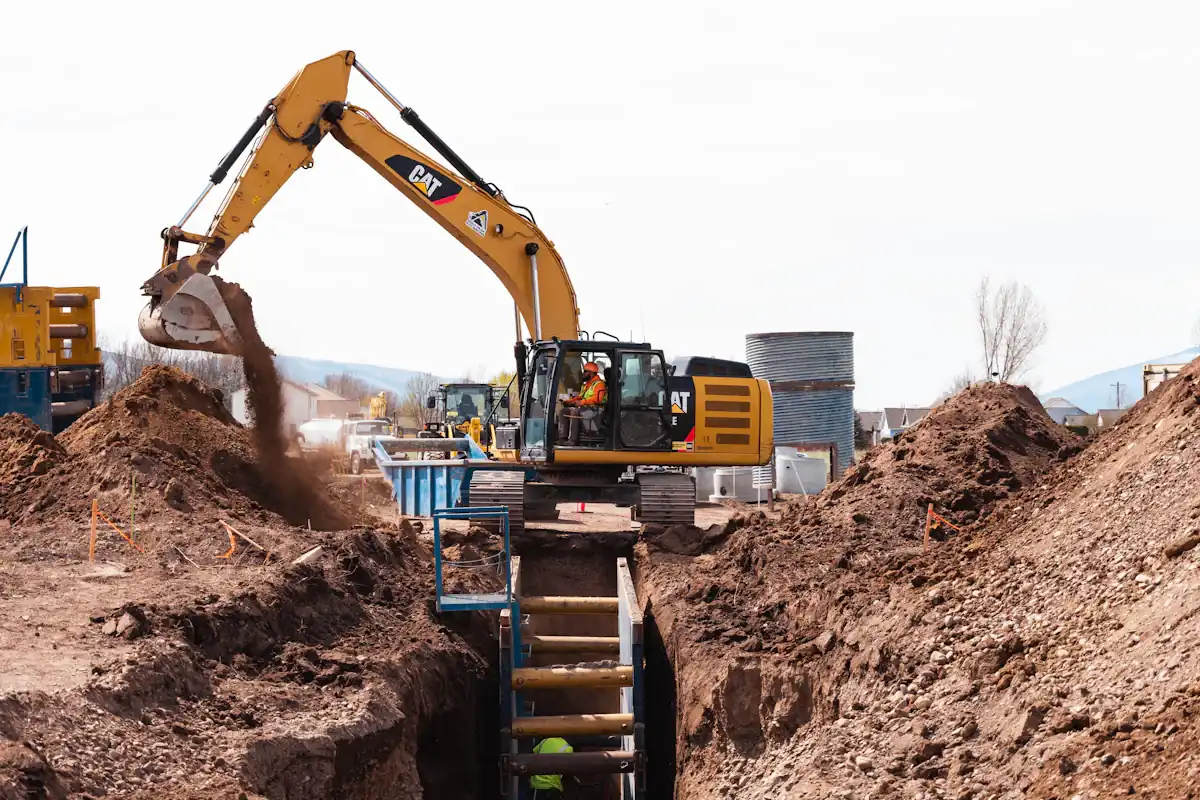
We start by calling 811 to mark utilities on every job. This is required by Texas law before any excavation and is non-negotiable. After confirmation, we walk the site with the homeowner to confirm the intake location, verify outlet options, and check grade using a hand level or laser level. A French drain with a flat run doesn’t drain, minimum fall is 1 inch per 8 feet, and we target 1 inch per 4 feet where the site allows.
Trench depth depends on what the drain is solving. Surface runoff and yard pooling problems use 12 to 18 inch trenches. Foundation perimeter drains that need to intercept groundwater before it reaches the footing go to 24 to 36 inches, deep enough to place the perforated pipe below the bottom of the foundation. Trench width is typically 12 to 18 inches to allow adequate gravel volume on each side of the pipe.
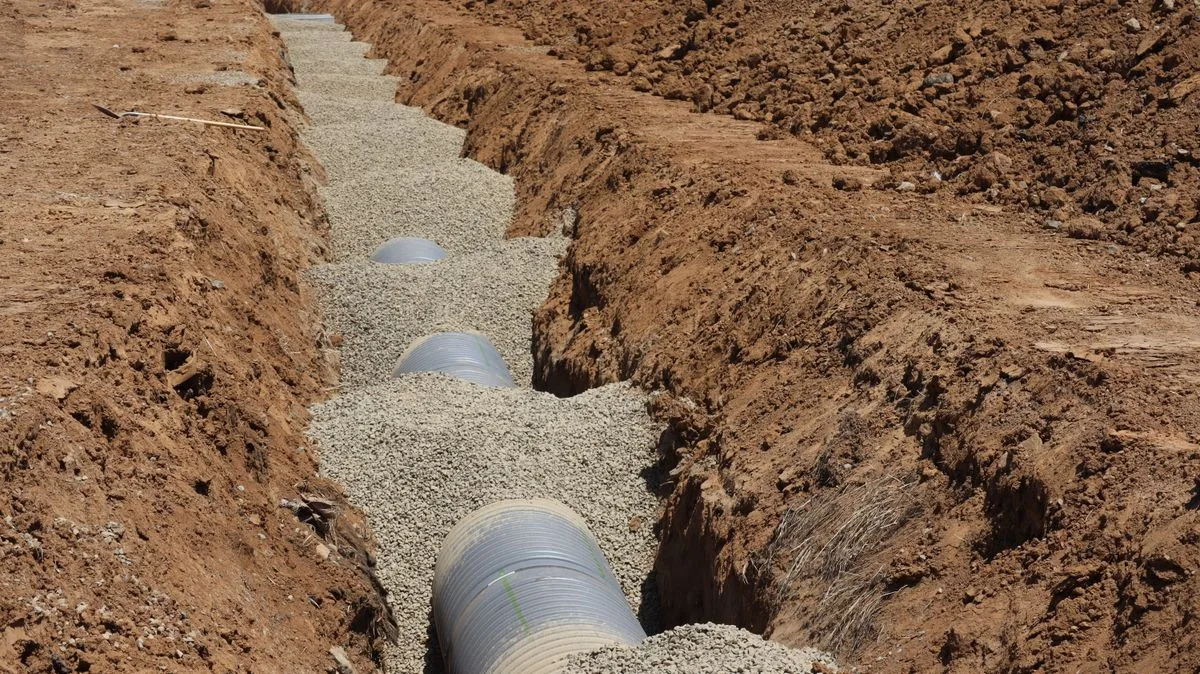
We lay 2 to 3 inches of clean angular stone in the trench bottom before pipe placement, set the perforated pipe at the correct fall, fill gravel around and over the pipe to within about 3 inches of grade, wrap the full assembly in non-woven geotextile filter fabric, and backfill the remaining 3 inches with topsoil or sod to restore the surface. The outlet terminates at the street curb, a drainage easement, or a dry well depending on the site. We cap the outlet with a rodent guard to prevent nesting.
Final step is a flow test: we run water into the intake zone and verify it discharges at the outlet within the expected time. If a section doesn’t flow, we identify the cause before we leave. Every job includes cleanup and surface restoration.
French Drain Costs in Melissa TX
Pricing in Melissa is consistent with the broader North Texas market. The primary cost drivers are linear footage, excavation difficulty (dry clay digs faster than saturated clay), outlet complexity, and whether the system includes catch basins or only trench drain. These ranges reflect current labor and material costs in Collin County.
| System Type | Typical Range | Notes |
|---|---|---|
| Single-trench, one foundation side (40-60 ft) | $2,500 to $4,000 | Most common job type in Melissa |
| Two-side perimeter system (80-120 ft) | $4,000 to $7,000 | Includes corner outlet transition |
| Full perimeter system (150-200 ft) | $7,000 to $12,000 | Typical for corner lots or total yard drainage |
| Catch basin + underground pipe system | $3,500 to $8,000 | For driveways, patio areas, multiple low spots |
| Combination French drain + catch basin | $5,000 to $14,000 | Complex yards with both runoff and groundwater issues |
Every quote is free and done on-site. We don’t quote from satellite imagery because Blackland clay’s local variations, subsurface utility locations, and outlet options all require a site visit to price accurately.
Best Time to Install a French Drain in Melissa TX
Late summer through fall, roughly August through November, is the optimal installation window in Melissa. Blackland clay in its contracted, dry-season state excavates significantly faster than saturated clay. Dry clay holds trench walls cleanly, reducing the risk of sidewall collapse during digging, and the surface restoration settles more predictably. A system installed in fall can be tested and flow-verified before the following spring storm season (March through May), which is when Melissa sees its highest rainfall concentration and drainage demands.
Spring installation is common because that’s when homeowners discover their drainage problems, and we do install year-round. But saturated, expanded Blackland clay is harder to excavate, slower to clean up, and takes longer to settle around the new pipe. Expect slightly longer project timelines and slightly higher labor costs for spring jobs in wet conditions.
French Drain Installation Melissa TX: FAQs
Questions we answer on nearly every site visit. If yours isn’t here, ask us on the estimate.
How much does French drain installation cost in Melissa TX?
How deep do you install French drains in Melissa TX?
Why does Melissa TX need French drains more than other areas?
What is filter fabric and why does it matter in Melissa?
Do French drains need maintenance?
Do French drains work in heavy clay soil like Melissa's?
Can I install a French drain myself in Melissa TX?
Where does the water go after it enters the French drain?
When is the best time to install a French drain in Melissa TX?
How long does French drain installation take in Melissa?
Free on-site estimate. Melissa, Anna, Van Alstyne, and all of Collin County.