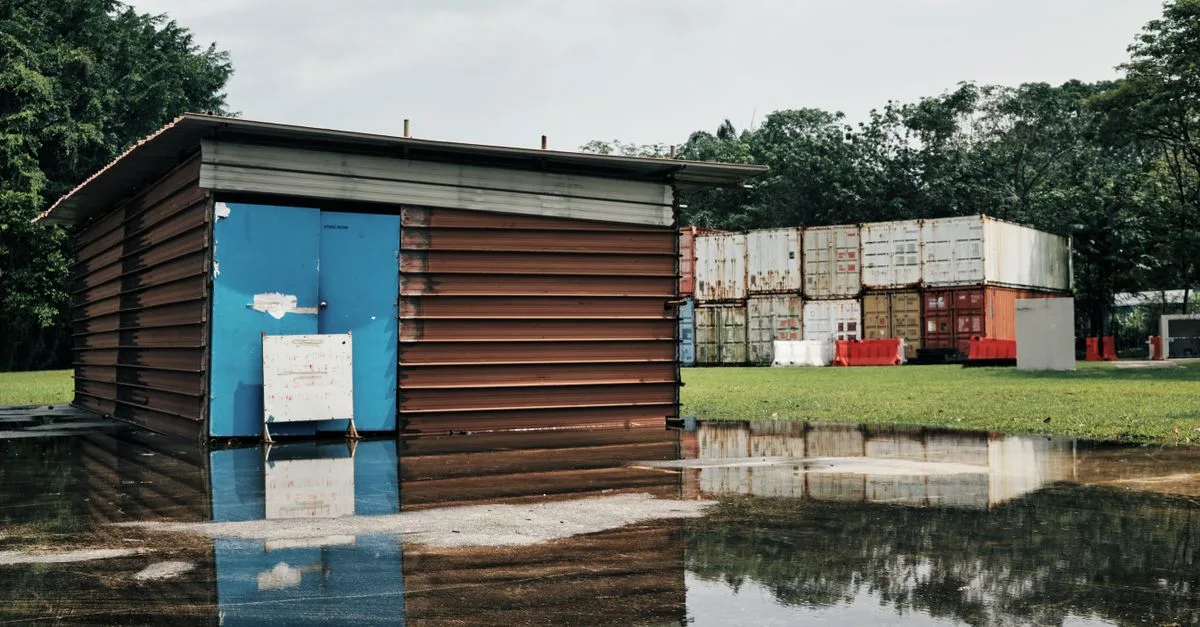
Standing water in a North Texas yard has two possible root causes: the water has nowhere to go because the ground is flat or slopes the wrong way, or the ground cannot absorb water fast enough regardless of slope. The fix depends entirely on which problem you have. Regrading solves the first. A french drain solves the second. In Collin County, where Blackland clay soil covers most of Melissa and the surrounding communities, you frequently have both problems at once.
Here is how to diagnose which problem is driving your standing water, and which solution makes sense given North Texas soil conditions.
What Regrading Fixes
Regrading is the right answer when standing water is caused by incorrect slope. Water flows downhill, and if your yard is flat, bowled in the middle, or slopes toward the house, it will pool wherever gravity takes it. Regrading moves soil to establish positive drainage away from structures and toward outlets like the street, a swale, or a low point at the property edge.
This is a grade problem. The pooling area needs to be raised, or a channel needs to be cut to a lower outlet. A french drain installed in a bowl with no outlet is just an underground pool.
Negative grade against the foundation is one of the most damaging drainage failures in North Texas. The correct fix is regrading the first 6 to 10 feet away from the foundation to slope at a minimum 2 percent away from the structure. A french drain interceptor can complement this but does not substitute for correcting negative grade.
Sheet flow from adjacent properties requires intercepting the water before it reaches your yard. A swale or interceptor drain at the property edge handles this better than regrading your own yard.
What a French Drain Fixes
A french drain is the right answer when water pools because the soil cannot absorb it fast enough, even with adequate slope. In Collin County, this is the dominant scenario because Blackland clay has extremely low permeability. During a heavy rain, water saturates the top clay layer within minutes and then has nowhere to go. The yard can slope correctly and still pool, because the water is moving across the surface of the clay rather than through it.
The slope is working, but the clay is not absorbing. A perforated pipe system installed below the clay layer intercepts the water and carries it to an outlet before it pools. This is the most common french drain application in Melissa, Anna, and Van Alstyne.
A consistent pooling location indicates a natural low point where clay saturation accumulates. A french drain running from the collection point to a lower outlet resolves this permanently.
Normal soil drains standing water within a few hours. Water that stands for a day or more is sitting on saturated or nearly impermeable soil. Clay soil in Collin County regularly produces this behavior. A french drain provides the mechanical drainage that the soil cannot.

Why Blackland Clay Changes the Math in Collin County
Most national drainage guides assume moderate-permeability soil, where regrading alone can solve most residential standing water problems. That assumption does not hold in Collin County. Blackland clay is among the lowest-permeability soils in the United States. Its hydraulic conductivity is measured in fractions of an inch per hour, compared to sandy loam that drains several inches per hour.
This means that a Collin County yard with a correct 2-percent slope away from the house can still produce standing water after a 2-inch rain event because the ground cannot move surface water fast enough and cannot absorb what it receives. The clay surface acts as a slow-moving sheet, and any low point or obstruction becomes a collection zone.
In this environment, the most durable drainage solution is almost always a combination: regrade to establish positive slope, then install a french drain to handle the volume the clay cannot absorb. Either alone addresses part of the problem. Together, they produce a yard that drains reliably through North Texas storm events.
How to Diagnose Your Specific Problem
Place a 4-foot level on the ground in the pooling area and measure whether the bubble sits level or shows a slope. Ground should slope away from the house at least 1 inch over 10 feet. If it slopes toward the house or is completely flat, grade is part of the problem.
If standing water drains within 2 to 3 hours once rain stops, the soil is absorbing adequately and grade may be the primary issue. If water stands for 12 to 48 hours after rain stops, clay permeability is the dominant problem.
Any french drain needs somewhere to discharge. Walk your property and identify the lowest accessible point: street curb, alley, drainage easement, or low area at the property boundary. If no outlet exists at a lower elevation than the pooling area, regrading to direct water to an outlet is a prerequisite.
Common Questions
Can I fix standing water in my Melissa TX yard with regrading alone?
How deep does a french drain need to be in North Texas?
How much does it cost to regrade a yard in Melissa TX vs installing a french drain?
Get a Free Drainage Assessment in Melissa TX
We assess your grade, soil, and outlet options and give you a written quote for the right solution before any work starts.
- Free on-site yard assessment
- Grade and soil evaluation included
- Written quote before any work begins
- Licensed and insured in Texas
- Serving Melissa, Anna, Van Alstyne, and Collin County